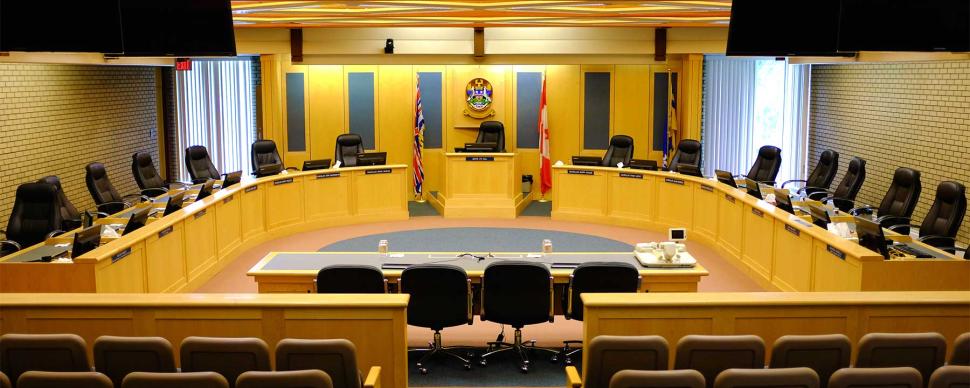
Facilitated Meetings the Stage is Set: Behind the empty seats of Prince George City Council chambers lies the framework of facilitated control.
Facilitated Meetings are often presented as a “tool” for democratic engagement. But without careful design, they can quickly transform into a “trap” for both the organizers and the participants.
The distinction between the two depends on whether the facilitation is used to open up a conversation or to narrow it down toward a predetermined conclusion.
1. The Hidden Strategy Behind Effective Facilitated Meetings
When used as a tool, facilitated meetings provides the structure necessary for a diverse group of people to move from “chaos” to “consensus” (or at least mutual understanding).
- Leveling the Playing Field: A skilled facilitator prevents “the usual suspects” (the loudest or most powerful voices) from dominating, ensuring that quieter participants are heard.
- The “Groan Zone” Management: Every complex decision goes through a period of confusion and disagreement. Facilitators guide groups through this “Groan Zone” so they don’t give up before reaching a creative solution.
- Translating Technical Language: They act as a bridge between technical experts (like urban planners or engineers) and the lived experience of residents, ensuring everyone is speaking the same language.
- Building Public Trust: Transparency in the process—where everyone can see how an idea moves from a sticky note to a final report—builds legitimacy for the eventual decision.
2. When a Facilitated Meeting Becomes a “Trap”
The “trap” occurs when facilitated meetings are used as a PR shield to give the illusion of participation while the real decisions remain behind closed doors.
- The Decoy Effect: Meetings are held after the “big” decisions (like budget or location) have already been made, leaving the public to only provide input on trivial details (like the color of the paint).
- The “Airing Out” Trap: Sometimes, meetings are designed purely as “gripe sessions.” The goal is to let people vent their anger so they feel “heard,” while the facilitator has no intention of integrating their feedback into the plan.
- Technical Exclusion: Using overly complex data or rigid agendas to steer the group away from controversial but important topics.
- The “Democratic Deficit”: If the facilitator is hired by the developer or the government agency, they may subconsciously (or explicitly) steer the group toward a “preferred” outcome, a process often called “engineering consent.”
A Checklist for Evaluating Facilitated Meetings
To determine if a meeting is a tool or a trap, evaluate it against these three criteria:
| Feature | The Tool (Meaningful Engagement) | The Trap (Tokenism) |
| Timing | Early; before any major decisions are set in stone. | Late; after the plan is finalized and just needs a “check.” |
| Power | The public has a defined role in the decision-making. | The public is “consulted,” but there is no clear path for their input. |
| Flexibility | The agenda can change based on the group’s needs. | The agenda is rigid to avoid “uncomfortable” topics. |
| Neutrality | The facilitator is an independent third party. | The facilitator is a staff member with a stake in the outcome. |
To help you determine if a process is genuine or a “managed” performance, you can use these questions to pressure-test the transparency and intent of the organizers.
If the answers are vague, it’s a sign the meeting might be a trap designed for “manufacturing consent.”
A Checklist for Facilitated Meetings in Prince George
Ask these via email or at the start of the meeting to clarify the rules of engagement:
1. The Influence Question
“What specific aspects of this project are still open to change based on our feedback tonight, and which are already non-negotiable?”
- The Tool: They will give you a clear list (e.g., “The budget is set, but the layout of the park is up for debate”).
- The Trap: They say, “Everything is on the table,” yet the plans they show are highly polished and detailed.
2. The Feedback Loop Question
“How will our input be documented, and where can we see the raw data before it is ‘summarized’ in a final report?”
- The Tool: They offer a public portal, a “What We Heard” report, or real-time scribbling on the walls.
- The Trap: They take notes privately and promise a summary in six months (giving them time to filter out dissent).
3. The Facilitator’s Mandate
“Who hired the facilitator, and what is their success metric for this session?”
- The Tool: An independent firm hired to ensure a fair process.
- The Trap: A staff member or a PR firm hired specifically to “gain public buy-in” for a specific plan.
4. The “No” Question
“Is ‘doing nothing’ or ‘starting over’ still a valid option at this stage?”
- The Tool: Yes, if the public consensus shows the project doesn’t meet community needs.
- The Trap: No, the meeting is about how to do it, not whether to do it.
Understanding the IAP2 Spectrum of Facilitated Meetings
To truly understand where you stand, it helps to look at the IAP2 Spectrum of Public Participation. This is the industry standard used to define the “promise” being made to the public.
- Inform/Consult: Often feels like a trap (one-way communication).
- Involve/Collaborate: The “Tool” zone where you have a seat at the table.
- Empower: The gold standard where the public makes the final call.
One Final Tip: The “Room Layout” Test
When you walk in, look at the chairs.
- Rows facing a stage: This is a lecture (Inform).
- Round tables with markers and maps: This is a workshop (Collaborate).
- Small “breakout” groups led by staff members: Be careful; this is often used to “divide and conquer” a room that is united in opposition.
- The IAP2 Spectrum of Public Participation is the international gold standard for defining the “promise” an organization makes to the public.
The IAP2 Spectrum of Public Participation is the international gold standard for defining the “promise” an organization makes to the public.
If you want to know if a meeting is a “tool or a trap,” this table is your map. It moves from left to right, representing an increasing level of public impact.
| Level | Goal | The Promise to You | Example Tools |
| Inform | To provide objective info to help you understand the problem. | “We will keep you informed.” | Fact sheets, websites, open houses. |
| Consult | To get your feedback on analysis, alternatives, or decisions. | “We will listen to you and tell you how your input influenced the decision.” | Public comment, focus groups, surveys. |
| Involve | To work with you throughout the process so your concerns are understood. | “We will work with you to ensure your concerns are directly reflected in the alternatives.” | Workshops, deliberate polling. |
| Collaborate | To partner with you in each aspect, including developing the solution. | “We will look to you for advice and incorporate your recommendations to the maximum extent possible.” | Advisory committees, consensus-building. |
| Empower | To place final decision-making in the hands of the public. | “We will implement what you decide.” | Citizen juries, ballots, delegated decisions. |
Where the “Trap” Happens in facilitated meetings
Most public frustration occurs when there is a mismatch between the level of engagement and the public’s expectations:
- The “Consult” Trap: The organization acts like they are “Collaborating” (asking for big ideas), but their actual promise is only to “Consult.” You spend hours on a vision board, but they only use your feedback to decide what color the sign should be.
- The “Inform” Masquerade: A meeting is advertised as a “Community Discussion” (Involve), but when you arrive, it’s just a 90-minute PowerPoint presentation (Inform).
- The Feedback Black Hole: In the “Consult” and “Involve” stages, the promise is to show you how your input was used. If they never release a report showing “You said X, so we changed Y,” they have broken the promise of the spectrum.
In the context of the Prince George Public Safety Town Hall (and the ongoing meetings of the Standing Committee on Public Safety in December 2025), the stakes are high. Residents are dealing with complex issues like street disorder, organized crime units, and downtown security.
1. Where Prince George Sits on the Spectrum
The City of Prince George explicitly references the IAP2 Spectrum in its “Get Involved” framework. However, most public safety meetings currently fall into the Inform or Consult categories.
· The Tool Aspect: The city is currently “Consulting” on very specific, actionable items—such as the Downtown Security Patrol tax and the “Hope and Healing Network” pitch. These have clear budgetary and policy implications where public sentiment can shift a Council vote.
· The Trap Aspect: Many “Town Halls” are technically Inform sessions. For example, the announcement of the new eight-officer organized crime unit on December 16th was a provincial decision. A town hall about this unit is an “Inform” session—there is no “Trap” if they are honest about it, but it becomes one if they lead you to believe you can vote the unit away.
2. Red Flags for PG Public Safety Meetings
Keep an eye out for these specific “Prince George” indicators:
The “Division of Powers” Trap
Public safety in BC is split between the City (Bylaws, RCMP contract), the Province (Health, Housing, Courts), and the Feds (Criminal Code).
- The Trap: If a facilitator allows the room to spend two hours arguing about “stiffer jail sentences,” they are trapping you. The City has zero power over sentencing. A “trap” meeting lets you vent about things the organizers can’t change so they don’t have to talk about things they can change (like street lighting or bylaw hours).
- The Tool: A facilitator who says, “We hear your frustration with the courts, but tonight we are only here to decide on the 24/7 Bylaw Patrol budget.”
The “Division of the Room”
- The Trap: Breaking the town hall into “small groups” where a staff member at each table records notes. This is a common tactic to “dilute” a strong, unified message from a frustrated crowd.
- The Tool: A “Fishbowl” or “Open Mic” format where everyone hears the same testimony and the organizers have to respond to the collective mood of the room.
- 3. Recommended “PG-Specific” Questions
- If you attend the next Public Safety meeting at City Hall, ask these to see if they are using the session as a genuine tool:
- · On Jurisdiction: “Since the Province just announced the new gang unit, is this meeting intended to help us shape how that unit interacts with our local businesses, or is this just an information session?”
- · On Actionable Items: “Council is currently debating the tax-funded downtown security patrol. Will the raw data from tonight’s feedback be published before the January budget talks?”
- · On the “Hope and Healing” Pitch: “A network of 30 non-profits was recently proposed to the committee. How does this town hall feed into the decision to grant or deny those organizations tax exemptions?”
Summary of Facilitated Meetings for Prince George
The City’s Standing Committee on Public Safety is currently in a high-pressure “Consultation” phase. It is a tool if you focus your energy on the Bylaws, Security Patrols, and Zoning—the levers the City actually pulls. It is a trap if the meeting is used to “buffer” the public’s anger without providing a clear path to the 2026 budget.
“BC Ombudsperson’s best practices for local government”
Data and media used on this page are provided with respect to the original creators. See my full [Attribution & Credits] page for more details.